
Government and Economics – Unit 5: The Christian and His Government
THE CHRISTIAN AND MEDIA
"Indeed, I tremble for my country when I reflect that God is just."
- Thomas Jefferson

Followers of Jesus are followers of the truth. Jesus warned us about being deceived by false teachers (Matthew 24:4).I John 5:6 informs us that the Holy Spirit is truth. These and many other passages in the Scripture tell Christians to be careful to not only speak the truth but also to follow the truth in all things. When it comes to daily life in a free-speech society such as America, we must be cautious. Countless types of media vie for our attention and may try practically anything to do so. Often in the desire to be in the "limelight," different types of media may resort to distorting the truth.Each day we are influenced by the news, by conversation with our friends, and by the things we read. The opinion makers try to influence us each day, and many times they succeed. Who and what are the opinion makers?
Here is your goal for this lesson:
Identify the six main opinion maker forces that affect us

anonymityHidden from detection; secretive and without being recognized
biasedStereotyped against; prejudiced
censorshipThe act of removing what may be considered objectionable to people
contemporaryOf the present time; recent
editorial pageOpinion page of the newspaper, where readers and writers express their views
equal accessEvery political party receives the same radio/TV broadcast length and time of day
Federal Communication CommissionOversees the communications industry in America, and enforces broadcast laws
influencingThe power to produce a desired result
policyPlan; course of action
racketeerA person who obtains money illegally, sometimes by threat of physical violence
sound biteA short clip of TV footage which may cut a speaker's words to a few seconds of time
Vocab Arcade
Newspaper, magazines, television, radio, motion pictures, and other agencies are the chief opinion makers around us today. These media pour out thousands of images and words that carry a message of one kind or another. Television programs are careful to add the right "sound bite," a small clip of sound and image. Many times when Christians voice their objections to certain propaganda, there are cries of "censorship." Christians find out that they are being accused of being biased against free speech. What do we do? Let's take a look at those who try to persuade us to think one way or another.
Newspapers are powerful opinion-makers. Information is the key to intelligent public opinion. One of the most commonly used sources of information on public issues is the newspaper. Every town or city has one or more daily or weekly newspapers, and many city papers are distributed for hundreds of miles around the city. Almost every home receives at least one newspaper a day. Newspaper editors have often taken the lead in influencing public opinion, especially in local affairs. In some cities they have conducted campaigns against corrupt political bosses. In others they have exposed crooks and racketeers through the publicity of the newspapers. They have crusaded for improved housing and better streets. The public has been educated and steps are taken to remedy the condition.
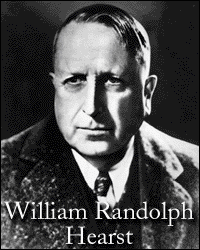 To consider newspapers a source of information, however, we need to consider that all are biased in some way. Newspaper publishers have very definite political, social, and economic beliefs. Many editors use their newspapers to promote these beliefs. Sometimes the same publisher has a chain of newspapers in various parts of the nation. William Randolph Hearst is a good example of a newspaper owner who used his newspaper for more than just reporting the news. Accused of "sensationalism" in his publications, Hearst nevertheless used blaring headlines and high-emotion articles to draw readers to his paper. Controversy surrounded his newspaper, New York Journal, in the late 1890s, as it was accused of overreacting to the sinking of the battleship Maine on February 15,1898 . The sinking was an occasion for the New York World and Hearst's New York Journal to print extra editions with shocking headlines and news items. Both rival newspapers warned readers that America was attacked by Spain and suggested that retaliation was the only alternative. There is still speculation today as to whether the newspapers of New York unethically helped contribute to the Spanish-American War. The sensational reactions of the New York World and New York Journal helped people understand the power of a newspaper that has an agenda that goes beyond merely reporting the news.Christians should be aware of the very real danger of newspapers that abuse the truth in news to accommodate its own goals of attracting more readers..
The political viewpoint of a newspaper can soon be learned from reading its editorial page, where it takes a stand on the issues of the day. If it is a good paper, it will attempt to keep its editorial viewpoint out of its news stories, and you can read them to get the facts. Because so few newspapers succeed in being unbiased, one should usually read several newspapers for a variety of data. To read "behind the headlines" is especially important. Headlines are at times misleading, for the simple reason that to tell the whole truth in only a few words is impossible. We should therefore look upon the headlines as attention-getters only. To be informed requires careful reading of the facts behind the headlines.Select news magazines can be very helpful at this point.

Magazines can also carry a bias. Each week and each month dozens of magazines come off the presses to find their way into the homes. offices, and schools of America. Some of these publications sell millions of copies. Though magazines are of many types and subjects, all affect readers and thus public opinion in some manner. Contemporarypolitical, social, and economic issues are addressed in such news magazines as Time, Newsweek. and U.S. News and World Report.
Magazines of critical opinion are such magazines as American Spectator and New Republic. Monthly magazines which often contain articles on national and international matters are Harper's and Atlantic Monthly. Like newspapers, all magazines have their particular biases. These prejudices may be political, social, economic, religious, racial, or otherwise depending on those of the publisher and the group of readers to whom the magazine is addressed. Base your opinions on as many real facts as you can assemble from different sources. In reading any newspaper or magazine, search for the truth.
 World Magazine: A weekly Christian news magazine.
Television and radio carry a "see it now" impact. In 1998, when Senator John Glenn orbited the earth (over 30 years after he made his first space trip), the world was treated to the space liftoff via satellite pictures which took the action to every part of the world. The action was carried live instead of tape delay, reminding us that the impact of television and radio cannot be understated. The access which we now have in the 21st century is something that was barely dreamed of not too many years ago.
Television is even more effective than the radio as an agency for influencing public opinion. On the radio you can only hear the speaker; on television you can see him as well. The movement of the head, his gestures, his eye movement - all of the tricks of public speaking or dramatic art can now be employed to the greatest possible advantage. Experts attribute John Kennedy's appearance and manner as important as his substance during the 1960 televised debates.The same was mentioned in Bill Clinton's television debates and forums against challenger Bob Dole in 1998. Never has there been a greater instrument for influencing public opinion than television. This power is recognized by both political parties, which pay millions of dollars to build up and project the proper television image for their candidates.
The danger lies when inaccurate or incomplete information is presented as absolute truth. In 1989, the CBS television program "60 Minutes" stated that the spraying of Alar on apples was a major environmental and health risk. The sensational comments made on the news show created a furor among the American public. A group called the Natural Resources Defense Council (NRDC) claimed that eating Alar-laden apples significantly increased a child's risk of developing cancer. As a result scores of school districts across America dropped apples from their menus and parents poured apple juice down the drains. Apple sales plummeted and a lawsuit was brought against CBS in order to address the claims that were made.
Was Alar causing cancer in children? After all data were reviewed, the World Health Organization stated that Alar was shown to be noncarcinogenic and cleared it for reinstatement on food crops. In fact, the only way that Alar could have been shown to be carcinogenic was if a person would have Alar in doses in the equivalent of drinking over 4,000 gallons of apple juice per day for life. The Alar "scandal" was a lesson for many broadcasters in learning the importance of providing responsible journalism, not unstable claims.
The official policy of broadcasting companies is to present all sides of a controversial political issue. By Federal Communications Commission rules, at election time both major parties are entitled to equal amounts of time to present their programs. If one political party makes charges against the other, the broadcasting companies are bound to grant equal time to the other party for its answer. This is known as equal access. News commentators influence public opinion greatly. These journalists might be classed as "editors on the air." Sometimes they air their own opinions, and sometimes they slant their interpretations to suit their sponsors. Therefore, to get a true picture of events, we should listen to more than one commentator and read background articles in books and magazines.
The radio and television media perform a public service in the field of political education. The many discussion programs bring different viewpoints before the people. The practice of interviewing persons who are in the headlines, such as in "Meet the Press," or "Face the Nation," is especially informative.
The Internet is quickly gaining strength as a powerful influence among people today. People are treated to split-second information, on-the-site surveys, and Web Pages of easy-to-gather news. A subscriber can literally reach a different opinion every minute by accessing different web pages. With the relative anonymity of both the writers and the readers, opinions have become stronger and even explosive. For every hard-hitting message of moral uprightness there is an opposite view which promotes immorality and deceit. Christians must be aware of the differences, using the light of God's Word. II Corinthians 13:8 tells the Christian to work towards the truth only.
Learn to Evaluate Internet Sites!
Our opinions are influenced in other ways. Public opinion is influenced by the home, church, and school. Most of our ideals are cultivated in the home and the church. Many issues are discussed at dinner tables, or in family gatherings in the home. These discussions are often stimulated by discussions in the school or by some television program. Many of us form our opinions on issues as a result of these home influences. Also, many of us favor one political party or another because of home and family tradition. Most young people favor the Democratic or the Republican party, not because they have thought through political policies, but because their families have belonged to one or the other.
Education is the basic requirement for an enlightened public. Proverbs 10:23 tells us Read Proverbs 10:23 - 23 In other words, a wise person will seek to understand an issue, but a fool will cause problems all along the way due to his ignorance. An uninformed person can cause damage at the voting booth, in the town hall meeting or even among his friends. Uneducated opinions are dangerous. Hearing rumors, whether given by a local gossip or an irresponsible television network, is dangerous.
© 1999, 2002, 2005, 2011 Glynlyon, Inc.
https://monarch.aop.com/curriculum/review/172517099/7
Comments
Post a Comment